The Role Of Iot In Modern Warehouse Management

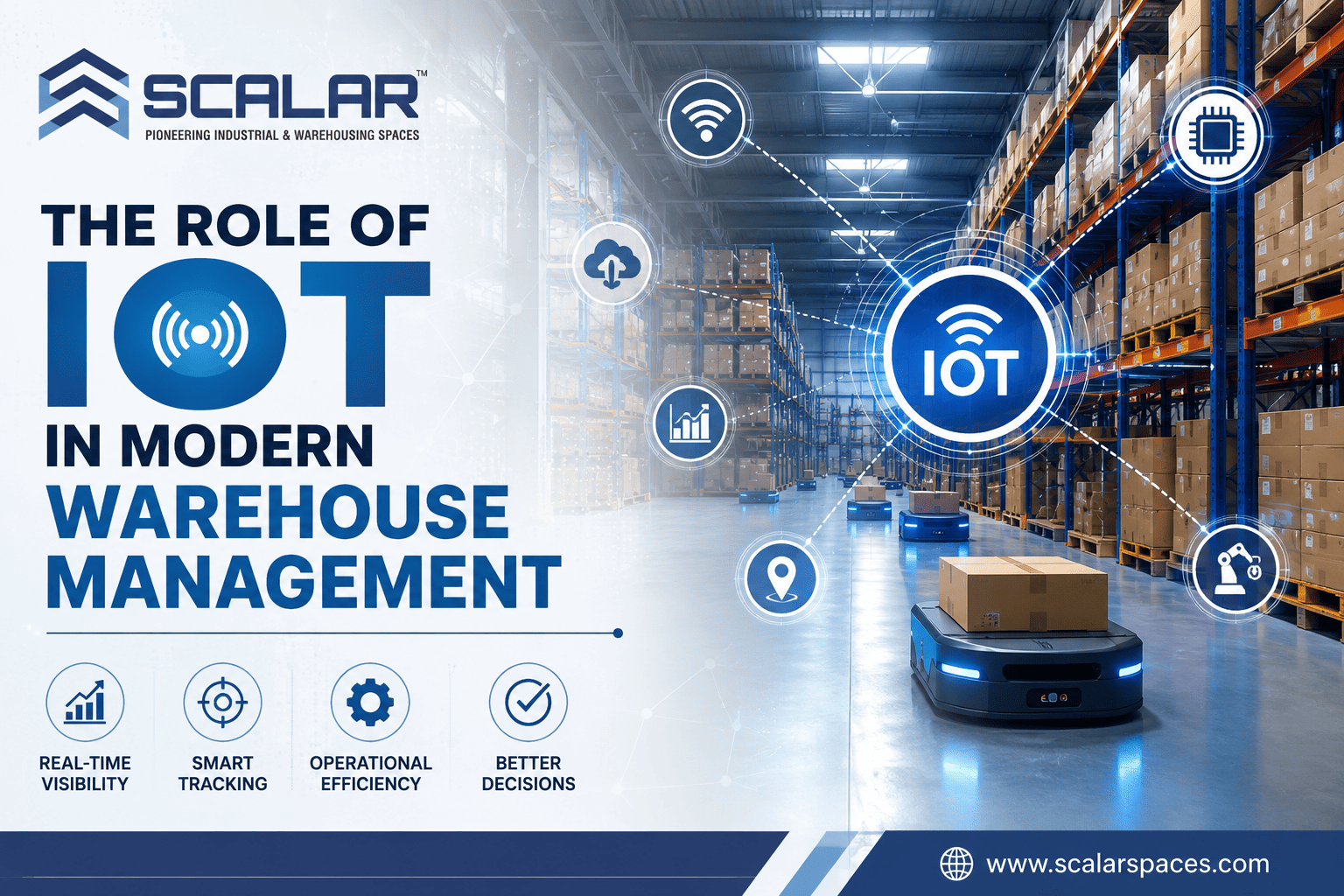
The modern warehouse is rapidly evolving from a traditional storage facility into an intelligent and connected ecosystem. As businesses are trying to meet the increasing demands of the customer and improve operational efficiency, the Internet of Things (IoT) has emerged as a key factor of warehouse transformation.
In this blog we will discuss more about the Internet of Things, how it is changing the modern warehouse management system and why to choose our Grade A warehousing solutions at SCALAR SPACES for an advanced technology for your business.
What Is Iot In Warehousing?
IoT simply means connecting physical devices to the internet so they can collect and share data in real time. In built-to-suit solutions, these could be sensors on shelves, trackers on forklifts, or scanners on pallets, all connected to a central system. Instead of a manager physically walking around to check stock, the data comes straight to their screen. In smart warehouse machines and technology do most of the tracking and reporting work automatically.
Why It Matters In Modern Warehousing?
Warehouses today are not just about storing goods anymore, they are about speed, accuracy and customer satisfaction. E-commerce has led delivery expectations to same-day or next-day, and that kind of speed is only possible when a warehouse knows exactly what it has, where it is, and how fast it can move. This is exactly why the role of IoT in warehouse management has become so important.
It reduces manual errors, saves time, cuts down operational costs and gives businesses real-time visibility into their inventory.
Key Applications Of Iot In Warehousing
There are several ways IoT is being used practically inside warehouses today, and understanding these applications helps explain IoT in modern warehouse management in a clear way.
1. RFID Technology for Inventory Tracking
RFID technology is one of the most common IoT applications in warehousing. Small tags attached to products send signals to readers placed across the warehouse, allowing businesses to track exact stock levels without manually scanning every single item. This drastically reduces the time spent on inventory audits and prevents stock mismatches.
2. Smart Sensors for Environmental Monitoring
Sensors placed inside storage areas can monitor temperature, humidity and lighting conditions. This is especially useful for warehouses storing perishable goods, pharmaceuticals or electronics, where even small changes in environment can damage the product.
3. Automated Guided Vehicles (AGVs)
IoT-enabled AGVs move goods within the warehouse without needing a human driver. These vehicles communicate with the central system to understand where items need to go, making the movement of goods faster and safer.
4. GPS and Fleet Tracking
For warehouses that also manage transportation, IoT devices help track vehicles in real time. This ties directly into smart logistics, where businesses can predict delivery times more accurately and reroute vehicles if there’s a delay.
5. Predictive Maintenance
Machines and equipment fitted with IoT sensors can alert warehouse managers before something breaks down. Instead of waiting for a machine to fail and stop operations, the system predicts issues in advance, saving both time and repair costs.
Iot And Warehouse Management Systems
A Warehouse Management System (WMS) is basically the software brain of a warehouse, and IoT acts as its eyes and ears. Here’s how the two actually work together in practice:
1. Real-Time Data Feed into WMS
IoT devices like sensors, RFID tags and scanners constantly collect data from the warehouse and feed it directly into the WMS. This means stock levels, order status and equipment condition are updated automatically, without anyone manually entering information.
2. Better Inventory Accuracy
Since the WMS is receiving live updates from IoT devices, the chances of stock mismatches or human counting errors drop significantly. Managers always know exactly what’s in stock and where it’s placed.
3. Faster Order Processing
When IoT and WMS work together, the system can automatically guide staff or automated vehicles to the exact location of an item, speeding up picking and packing. This directly improves how quickly orders move out of the warehouse.
4. Smarter Decision-Making
The WMS uses the data collected through IoT to generate reports and insights, helping managers make quicker and more informed decisions about restocking, staffing or equipment maintenance.
FAQ’s
1. Is IoT only useful for large warehouses, or can small businesses use it too?
A. Small warehouses can start with basic sensors or RFID tags and expand later as the business grows.
2. How is IoT different from just using barcodes in a warehouse?
A. Barcodes need manual scanning every time, while IoT devices continuously send data automatically.
3. Is IoT expensive to set up in a warehouse?
A. Better stock management and lower labour costs, making it worth the investment over time.
Conclusion
IoT has clearly changed the way warehouses function, making them faster, smarter and far more accurate than before. So if you are looking for reliable leasing warehouse service in Hyderabad, then SCALAR SPACES is your best choice. Contact us today.
Follow Us On Instagram.