Warehouse Requirements for Automotive and Manufacturing Businesses

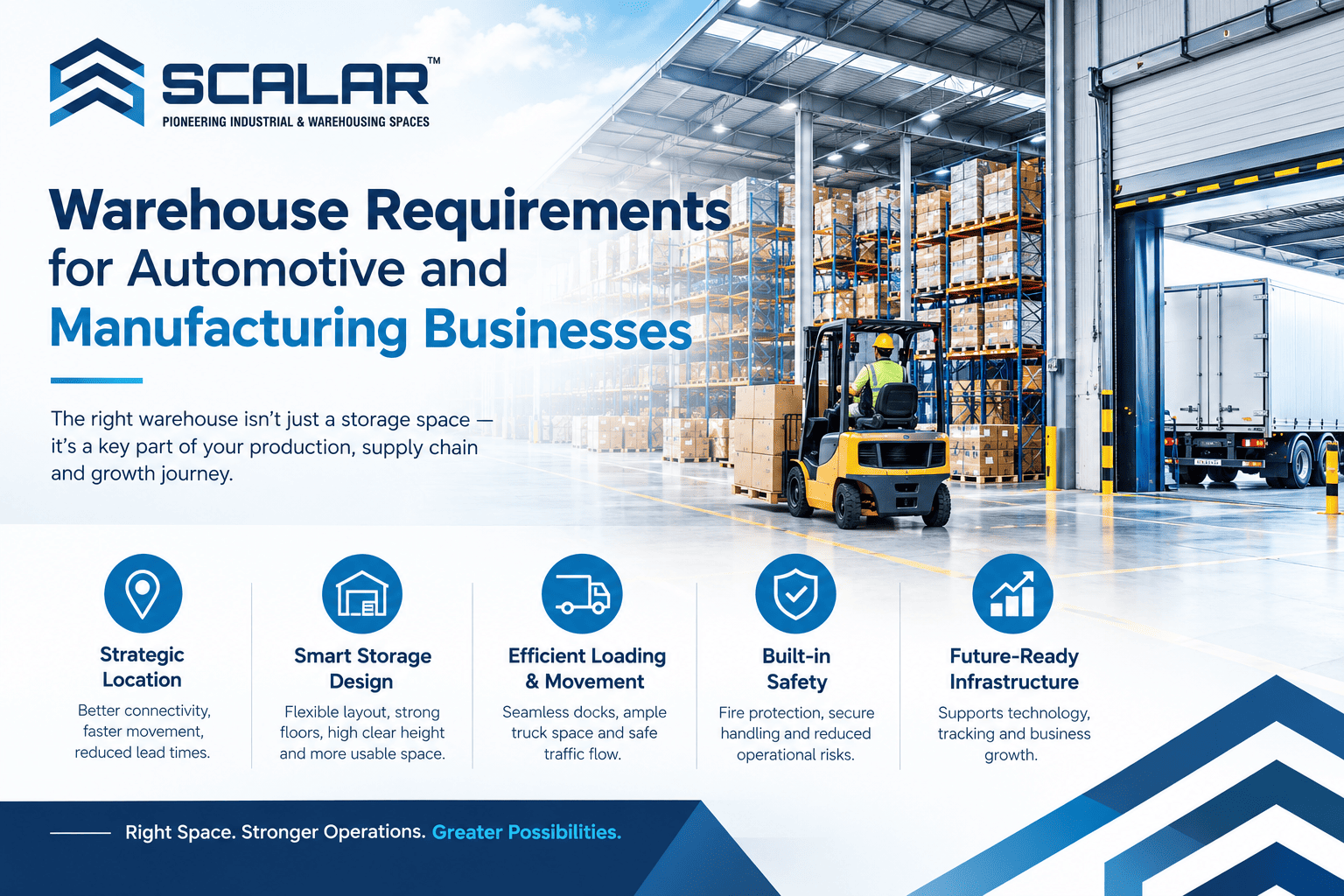
When it comes to automobile and manufacturing companies, a warehouse is more than just a storage space for their inputs or outputs. Warehouses are actually an integral part of the production process. If there are delays in moving trucks, if the parts are not easily accessible, or if the storage capacity does not adjust to the changes in stock, then the whole manufacturing process will be slowed down.
The ideal warehouse should align with the operations of the company. This is true in terms of its geographical location, loading and unloading, its floor strength, storage arrangements, and safety.
Location That Supports Faster Movement
For automotive businesses especially, warehouse location can directly affect the production schedules. Many manufacturers work with frequent deliveries and limited inventory buffers, making dependable movement between suppliers, warehouses and factories important. NITI Aayog has also highlighted optimised warehouse siting and connectivity as important for reducing travel distance and lead times.
This makes industrial clusters and established manufacturing corridors valuable when choosing a facility. Scalar Spaces has a presence across locations including Maraimalai Nagar in Chennai, Bandamailaram in Hyderabad, Kolhapur in Maharashtra and Sohna in Delhi NCR, giving businesses options across important industrial regions.
Space Designed for More Than Storage
Manufacturing warehouses often handle very different types of inventory at the same time. Raw materials, components, packaging, tools and finished goods may all require different storage arrangements.
Flexible storage layout
A good facility should allow businesses to create clear zones for receiving, inspection, storage, picking, staging and dispatch. This reduces unnecessary movement and makes it easier to locate materials.
Strong floors and useful height
Heavy components and material-handling equipment place greater demands on the warehouse floor. Indian warehousing standards commonly consider high clear heights, strong floors and layouts suitable for racking and material-handling equipment. The 2025 warehousing handbook, for example, notes 10–12 metres as a common clear-height range for high-bay warehouses and highlights floors designed for heavy point loads and equipment traffic.
For a business comparing best warehouse rental options, usable storage volume can therefore matter just as much as the total floor area.
Loading and Vehicle Movement
A warehouse can have plenty of storage space and still become inefficient if trucks cannot enter, dock and leave easily.
- Adequate loading and unloading docks for expected vehicle volumes
- Sufficient truck-apron space for turning and manoeuvring
- Separate or clearly managed inbound and outbound movement
- Staging areas near docks for goods waiting to be dispatched
- Safe movement routes for forklifts, workers and vehicles
Government warehousing standards also specify considerations such as raised loading floors and substantial truck-apron areas to support heavy vehicle movement.
These details are particularly important for automotive businesses where multiple inbound components may need to be received and dispatched within tight time windows.
Safety Should be Built into the Facility
Automotive and manufacturing businesses may store heavy materials, packaging, machinery parts and, depending on the operation, materials that require specific handling.
A suitable warehouse should therefore have appropriate fire protection, emergency access, safe electrical infrastructure, clearly planned movement areas and procedures for protecting inventory. Warehousing rules also emphasise safe storage, identification of goods and protection against fire, theft and other risks.
Safety is not only about protecting products. A well-planned facility also reduces avoidable interruptions to everyday operations.
Infrastructure That Can Support Growth
A warehouse should work for the business today without becoming a limitation tomorrow.
Modern facilities increasingly need to support inventory tracking, barcode-based identification, digital warehouse systems and better visibility of goods. NITI Aayog identifies digitisation, including warehouse management systems, as one of the factors that can improve picking, inventory counting, replenishment and reporting.
This is where choosing best warehouse leasing services can involve more than comparing rent. Businesses should also examine the facility’s infrastructure, accessibility, operating suitability and ability to support future expansion.
FAQs
1.What should an automotive warehouse have?
A. It should have suitable storage capacity, strong flooring, adequate clear height, efficient docks, vehicle access, safety systems and a layout that supports quick movement of components and finished goods.
2.Why is warehouse location important for manufacturers?
A. A strategically located warehouse can reduce travel distances and lead times while improving access to suppliers, manufacturing plants and customers.
3.Can one warehouse support both manufacturing and distribution?
A. Yes, depending on the facility and the operation. However, receiving, production support, storage and dispatch areas should be planned so that different activities do not interfere with each other.
Conclusion
For automotive and manufacturing businesses, the right warehouse is an operational asset rather than just additional floor space. Location, storage design, floor strength, loading infrastructure, safety and room for future growth all influence how efficiently materials move through the supply chain.
With strategically located industrial and warehousing facilities across key Indian markets, Scalar Spaces can help businesses identify space suited to their operational requirements. Explore best warehouse leasing services with Scalar Spaces and find a facility built around how your business moves.
Follow us on Instagram.